The short answer
Moving a boiler to a different location typically costs £300–£1,500 on top of the replacement price, depending on the distance moved and the complexity of re-routing the gas pipe, flue and water connections. All boiler relocation work must be carried out by a Gas Safe registered engineer and must comply with Building Regulations. For the full installation picture, see installation cost breakdown.
Homeowners sometimes want to move a boiler when reconfiguring a kitchen, converting a loft or simply freeing up a useful wall. It is often practical, but it costs more than a like-for-like swap and there are regulatory rules about where a boiler and flue can legally be positioned. Understanding both the costs and the constraints before commissioning the work avoids nasty surprises.
Boiler relocation at a glance
- Short move (same room) £300–£600 extra
- Room-to-room move £600–£1,500 extra
- Who does it Gas Safe registered engineer (mandatory)
- Rules Building Regulations Part J; flue clearances
- Notification Building Regulations approval or competent person scheme
- Key constraint Flue must terminate in a safe, compliant position
What a boiler move involves
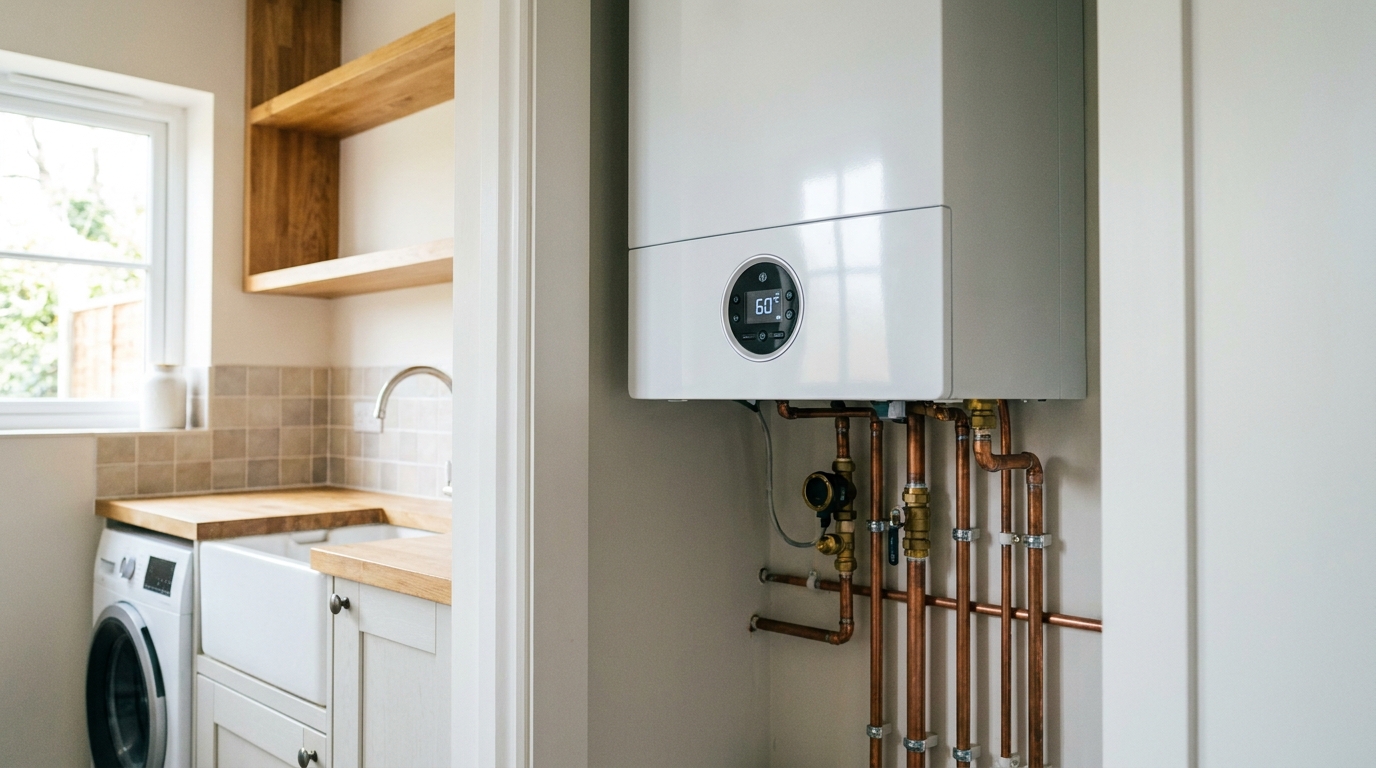
Moving a boiler means extending or re-routing: the gas supply pipe; the primary flow and return water pipes; the condensate drain pipe; and the flue terminal. A short move within the same room — say, 600 mm to 1 metre along the same wall — may need only minor pipe extensions and a new flue entry point, taking a few extra hours. Moving to a different room or floor involves running gas pipework through walls or ceiling voids, which is a more significant job and may require making good (plasterwork, tiles or flooring) after the work is done. The further the move, the more labour and material, and the higher the cost.
Rules and regulations for boiler positioning
A boiler cannot simply be placed anywhere convenient. Building Regulations Approved Document J sets out rules for combustion appliances and flue positions. Key constraints include:
- The flue terminal must be at least 300 mm from any opening into the building (windows, doors, vents) in most configurations, and at a safe height from the ground where it exhausts.
- The flue must not discharge directly below an opening window or into a passage where exhaust gases could accumulate.
- In some listed buildings or conservation areas, the appearance of the flue terminal on an external wall may require planning permission.
- Gas pipework must be run and tested to current gas safety standards; it cannot simply be extended with sub-standard fittings.
| Scenario | Typical extra cost | Complexity |
|---|---|---|
| Move within same room (<1 m) | £300–£500 | Low |
| Move to adjacent wall, same room | £400–£700 | Low–medium |
| Move to different room (ground floor) | £600–£1,000 | Medium |
| Move to loft or upstairs | £900–£1,500+ | High |
Moving to the loft
Loft boiler installations are less common but not unusual, particularly in houses converted to flats or where internal space is limited. A loft boiler must still comply with all ventilation and access requirements: the loft must provide adequate access for servicing, there must be a means of safely carrying out any work at height, and frost protection measures are usually necessary because lofts can fall below 0°C in winter. Some boiler manufacturers have specific guidance or installation requirements for loft installations. The flue route from a loft is often through the roof, which requires a specific flue kit and weatherproofing. Costs for a loft installation are toward the top of the range in the table above and may exceed it for complex flue routes.
Is moving the boiler worth it?
Whether the additional cost of relocation is worthwhile depends on what you gain. Freeing up a significant kitchen wall for a remodel, or relocating from a damp utility room to a dry internal cupboard, can justify the spend. Moving a boiler purely for aesthetic reasons — when the current position works well — is harder to justify given the cost. In all cases, discuss the intended position with your Gas Safe engineer before committing, as the feasibility and cost depend heavily on where the flue can legally terminate and how the gas pipe can be run. This is general information; all boiler relocation work must be planned and carried out by a Gas Safe registered engineer.
Frequently asked questions
Can you move a boiler to another room?
Yes, boilers can be moved to another room, subject to the flue being able to terminate in a compliant position and the gas pipe being properly routed. All such work must be done by a Gas Safe registered engineer and comply with Building Regulations Approved Document J.
Can I move my boiler myself?
No. Gas boiler relocation involves gas pipework and must be carried out by a Gas Safe registered engineer. DIY gas work is illegal and dangerous, and any work not certified by Gas Safe will affect your home insurance and may invalidate the boiler warranty.
How much does it cost to move a boiler in the UK?
Moving a boiler within the same room typically adds £300–£600 to the installation cost. Moving to a different room costs £600–£1,500 extra depending on the pipework runs and flue route. Loft installations may cost more.
Do I need planning permission to move a boiler?
Usually no, as boiler installation is covered by the competent person scheme (Gas Safe self-certification). However, if the flue terminal would be on a listed building or in a conservation area where its appearance affects the building’s character, planning advice may be needed.
Sources & further reading
- Gas Safe Register — gas pipe and boiler installation regulations
- GOV.UK / Building Regulations Approved Document J — combustion appliances and flue positions
- GOV.UK — competent person schemes and self-certification
- Energy Saving Trust — boiler installation guidance for homeowners
This is general information, not advice for your specific property or installation. Costs, timescales and outcomes vary with your home, system condition and chosen engineer. All gas boiler work must be carried out by a Gas Safe registered engineer.